
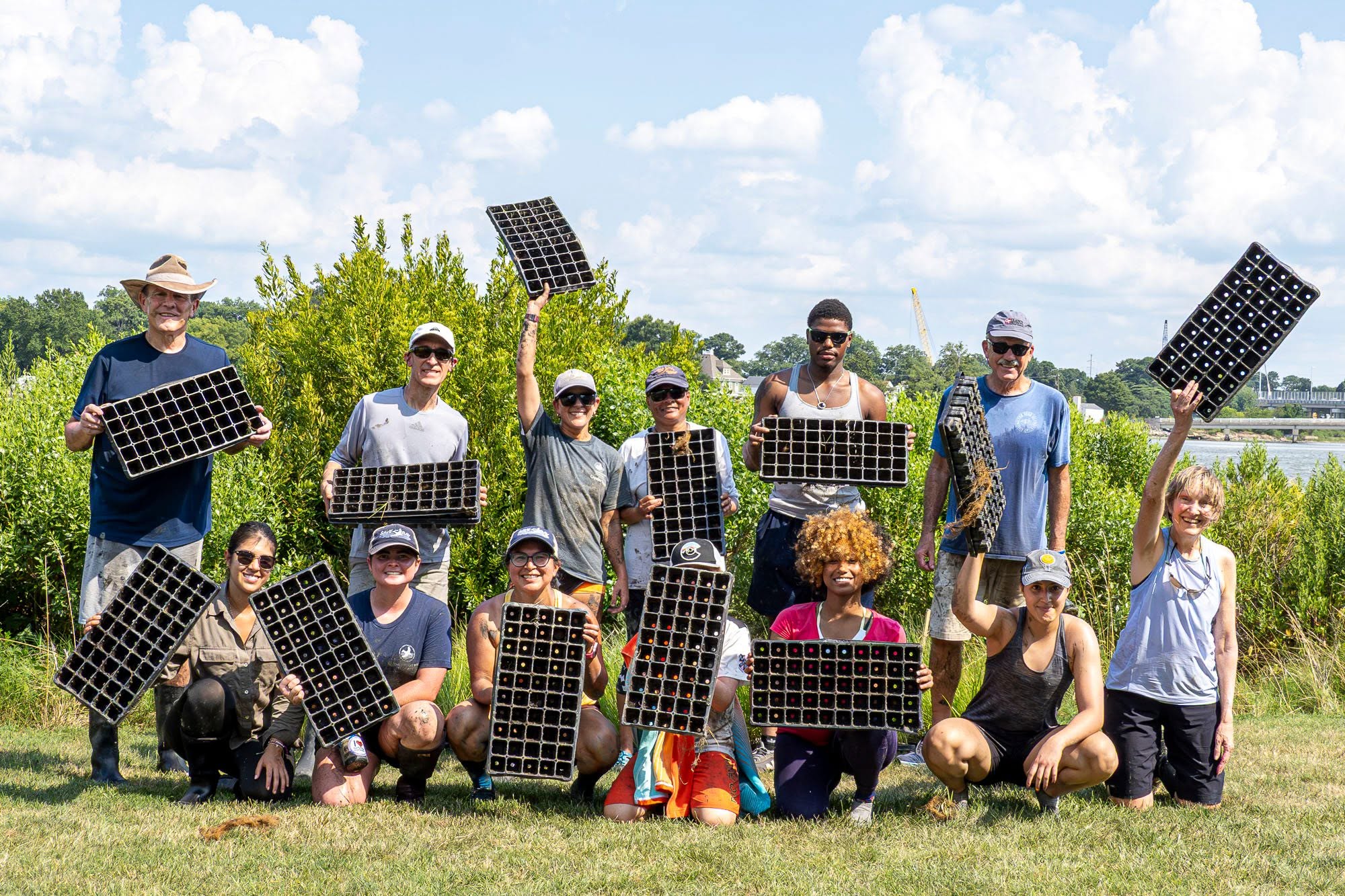
“Bless the Lord, O my soul. O Lord my God, you are very great… You set the earth on its foundations, so that it shall never be shaken. You cover it with the deep as with a garment; the waters stood above the mountains” (Psalm 104:1-2, 5-6, NRSV). Those verses framed the outdoor Mass that Immaculate Conception Catholic Church (ICC) held last fall in Hampton, Virginia, to close out a year defined by mud, marsh grass, and more than a thousand feet of new shoreline along the Hampton River.
Father John Grace has been a priest for more than 40 years and has shaped ICC into one of the most consistently creation-minded parishes in the region. Under his leadership, the church adopted full solar power with 440 installed panels in 2019, gave $40,000 to plant 40,000 trees in Kenya, and funded water filters for around 300 Navajo households in Arizona. “All our projects are about partnerships,” Father Grace told the Catholic Virginian. “We’ve made a commitment, and that’s where the impact really is measured.”
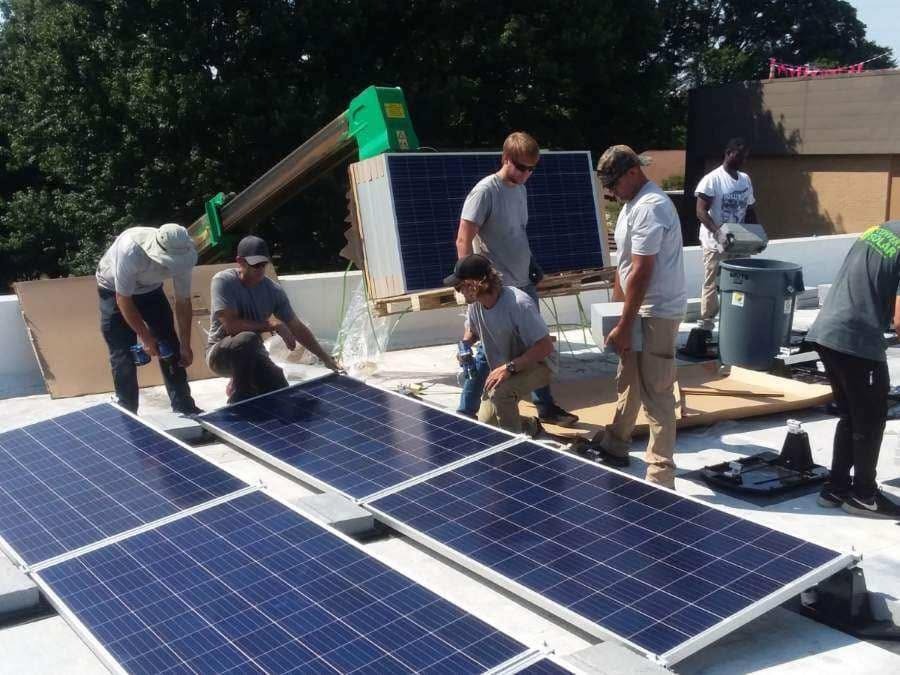
Photo Courtesy Immaculate Conception Catholic Church
Inspired by Pope Francis, whose 2015 encyclical Laudato Si’ taught that care for the earth and the poor are inseparable acts of faith, the parish also chose to build something living. “This whole thing came out from the idea of honoring Pope Francis, his legacy and his vision. We wanted to respond to his good example by also actively caring for creation in the spirit that he has given all of us,” said Father Grace.
The parish partnered with the Chesapeake Bay Foundation (CBF) and committed to the Pine Cone Harbour Buffer Project, otherwise known as the Francis Project: a living shoreline behind the Pine Cone Harbor Condominiums in Hampton, Virginia, on a stretch of the Hampton River in a community of roughly 138,000 residents where “polluted runoff from streets, parking lots, and buildings is one of the city’s biggest threats to clean water,” CBF restoration specialist Kati Grigsby told Chesapeake Bay Magazine. Father Grace added to the Catholic Climate Covenant that “All of our area is in the top 3 locations in the U.S. for sea level rise (and ground sinking). Even the Navy’s DRYdocks get flooded in extreme high tides, as do our streets in heavy rains. It is getting worse every year.”
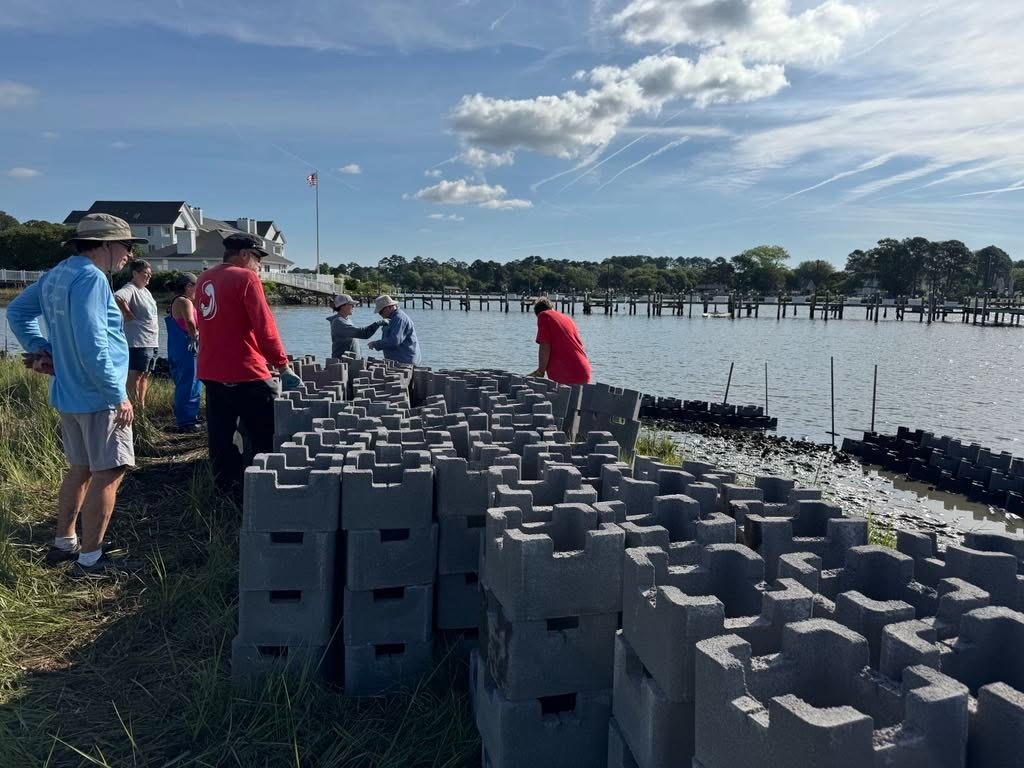
Photo Courtesy Immaculate Conception Catholic Church
Unlike a bulkhead or a seawall, a living shoreline uses plants and other natural elements to stabilize a coast, filter pollution, and rebuild habitat rather than simply holding a line against the tide, according to the National Oceanic and Atmospheric Administration (NOAA)’s National Ocean Service. Virginia has required living shorelines as the default approach to shoreline stabilization since 2020, unless a site’s conditions rule them out. ICC became the first church group to partner with CBF on the Francis Project, which marks CBF’s longest living shoreline to date. Father Grace explained that the congregation was “literally caring for our neighbors in terms of protecting homes from storm surge, expanding and protecting the wetlands and their biodiversity, and finding fellowship.”
Over 33 days between May and July, more than 100 ICC parishioners, the largest single volunteer group of roughly 200 total, which made up more than three-quarters of the project’s workforce, went to the river to build it by hand. They daisy-chained about 5,584 concrete blocks, or “oyster castles,” from the marsh down to the waterline, placed 720 bushels of recycled oyster shells, and planted 12,500 marsh grass plugs. Ultimately, they created new local habitats, raising 1,078 feet of living shoreline, 3,232 square feet of new intertidal oyster reef, and 9,514 square feet of low marsh wetland. The parish also gave $3,500 to sponsor the build.
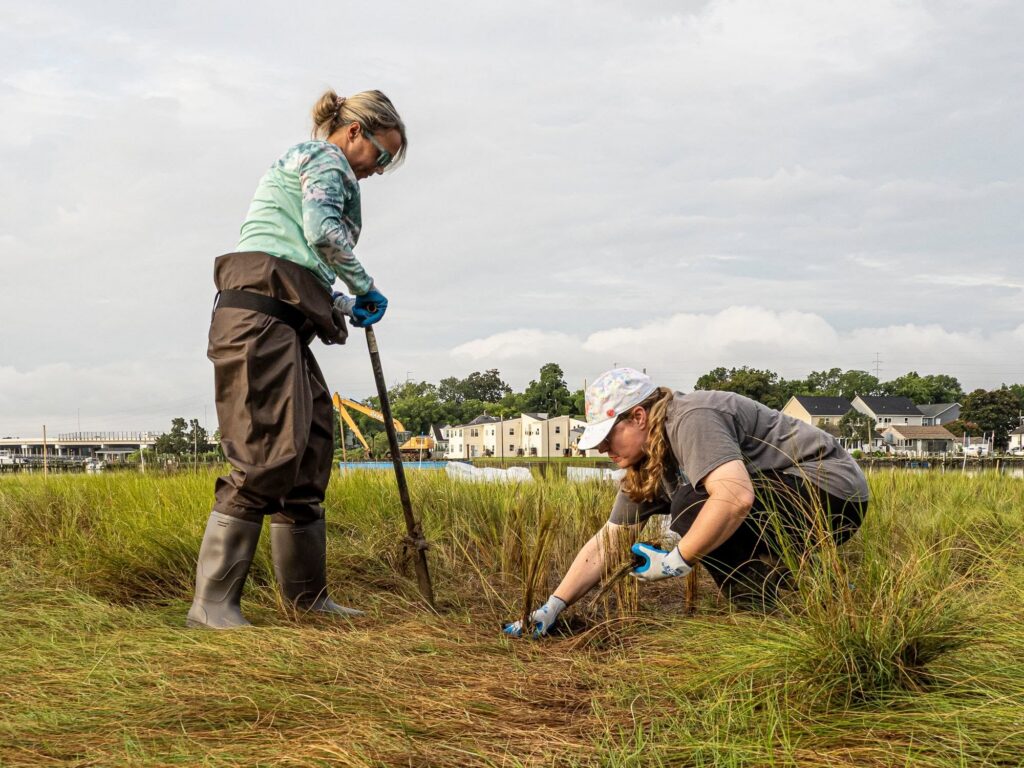
Photo Courtesy Kati Grigsby
Parishioner Tom Fahrenkrug, who volunteered on the project, described the spirit behind the labor simply: “Little by little, I think everyone can do a part and will save creation. It will be hard to do, but we can do it.” He explained why: “It’s important to keep America clean and to care for creation, or we may not have a world.” Fellow parishioner Tina White put the theology in her own words. “We’re not just supposed to use the earth; we’re supposed to take care of the earth. It is our responsibility,” she said. “He gave us this wonderful gift … The least we can do is help maintain and help make her better.”
That conviction showed up in small, physical ways. Father Grace described the scene as something like an old-fashioned barn raising: “It’s the old-fashioned barn raising idea that’s almost completely gone in today’s society. Our faith doesn’t stay in the doors [of the church], it goes outside, with a sense of shared responsibility.” One elderly volunteer, with a walker and an oxygen tank, gave a donation and asked Father Grace to “make sure someone plants my oyster castle for me.” The gesture became one of the defining images he carried away from the summer. Grigsby noted that not only were the ICC parishioners “probably the most loyal and most passionate volunteers out there,” but they also inspired others to keep working through the rain and heat: “They were there not only to lend a helping hand but also there to be support when we needed a little bit of a pick-me-up. It’s kind of hard for words to even describe how much their commitment to it meant to my team.”
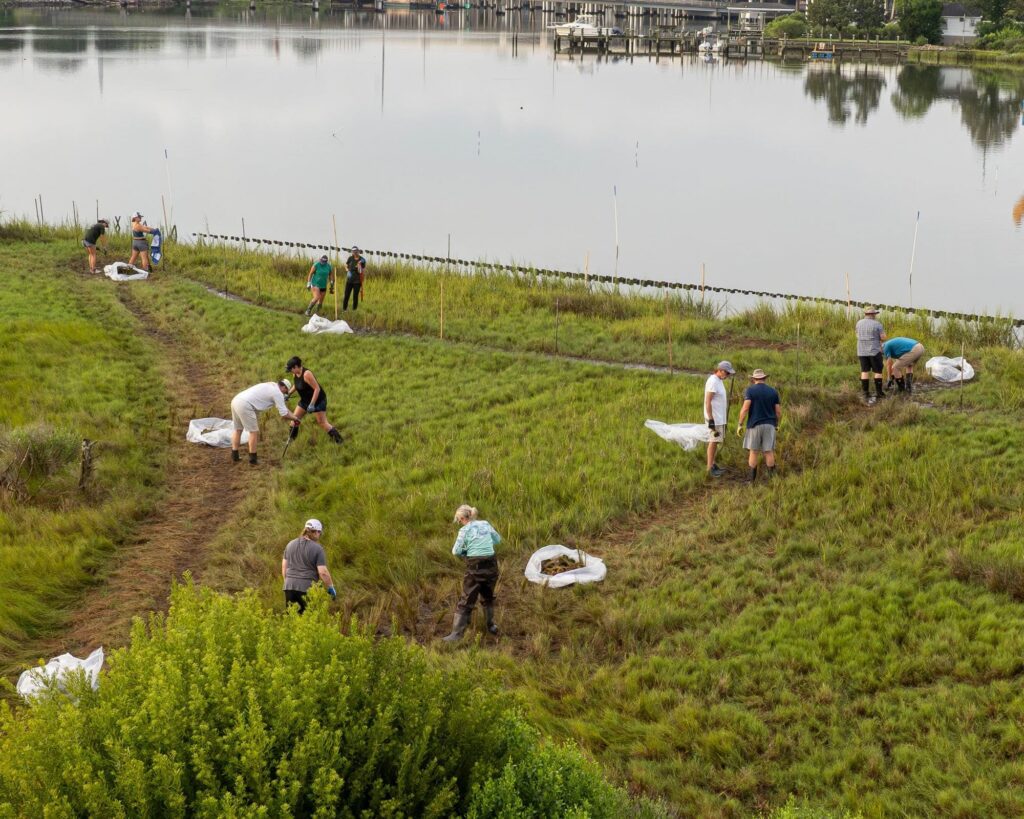
Photo Courtesy Kati Grigsby
The fruit came quickly. Within weeks, Grigsby reported, “Birds, crabs, and all sorts of juvenile finfish are using the area to hunt or find a little hiding space,” she said. Oyster larvae, called spat, attached themselves to the new reef as well. Former Cardinal Christophe Pierre, then the apostolic nuncio representing the Holy See to the United States, sent Father Grace a note of appreciation for the parish’s work, a small but meaningful sign that a single congregation’s labor on a Virginia riverbank had been noticed well beyond its banks.
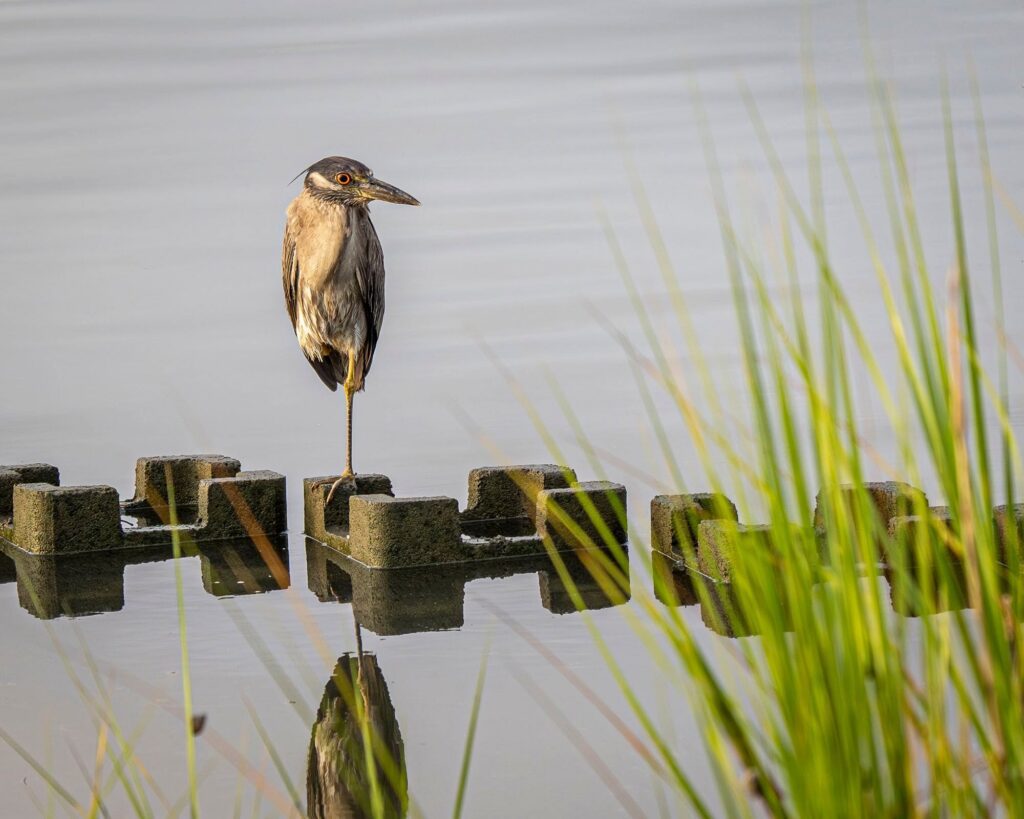
Photo Courtesy Kati Grigsby
The parish marked the end of the effort on September 12 with its first annual outdoor Mass for Creation, drawing worshippers to the same waters they had spent the summer restoring. Father Grace noted that the living shoreline project was “a natural extension of our ministry to care for God’s creation,” and acknowledged that “everybody is keenly aware of climate change,” which can lead to feelings of frustration or overwhelm. “With so many environmental issues making headlines, it’s easy to feel overwhelmed,” the church wrote in a newsletter. “However, meaningful change often begins with small steps and a shift in perspective. Pope Francis invites us to begin with a transformation of consciousness– a way of seeing the world that recognizes our responsibility to care for one another and for the Earth. From that foundation, both individual and collective action can grow.” Father Grace concluded, “We can do something and do it well.” Most recently, in April and May, volunteers again helped CBF, this time in creating a native perennial buffer that will allow the marsh to migrate.
What ICC’s parishioners did with oyster castles and marsh grass is a specific, muddy, three-month expression of a much older and broader Christian witness: that stewardship of the land is inseparable from love of God and of neighbor downstream. For a parish that measures its faith partly in trees planted, water filtered, and now marshland restored, the invitation extended to every reader is the same one Psalm 104 extends: to bless the God who set the world on its foundations, and to take up the work of caring for what he made.
 Copyright
2026
Root and Vine
Copyright
2026
Root and Vine