
“But let justice roll down like waters, and righteousness like an ever-flowing stream” (Amos 5:24, NRSV). At St. Ambrose Episcopal Church in southeast Raleigh, North Carolina, those words are more than scripture, they are a blueprint. Rain that falls on the church roof now moves through bio-retention beds and rainwater cisterns before it ever reaches Walnut Creek, the stream that runs behind the parish grounds.
St. Ambrose is a historically Black Episcopal congregation, and its relationship to that creek carries a long and painful history. For roughly 70 years, the city of Raleigh released raw sewage into Walnut Creek, which winds through a predominantly Black neighborhood. Haulers used the same wetland as an unofficial dump. “The city had been dumping sewage into Walnut Creek, into a black neighborhood, for 60 or 70 years,” from 1887 until 1956, Fr. Jemonde Taylor, who has served as St. Ambrose’s rector since 2012, recalled in the parish’s own published account of its environmental justice ministry. “There was no respect for the creek or for the residents. It was an unofficial dumping ground.” Anne S. Franklin, then-president of the Wake County Botanical Society, told Walter Magazine, “There were major issues with environmental degradation.” Then, in 1956, the city designated the area as one of two communities for Black residents during segregation.
The response started small. In the late 1990s, parishioners began pulling tires and litter out of Walnut Creek, and the cleanups built momentum. St. Ambrose joined with Trinity Episcopal Church in Fuquay-Varina and St. Paul’s Episcopal Church in Cary to form a new committee, the Episcopalians for Environmental Justice, later renamed Partners for Environmental Justice (PEJ) when secular neighbors and organizations joined the effort. Dr. Norman Camp, a St. Ambrose parishioner who had led the earlier cleanup efforts, founded PEJ in 1995 to confront the harm that local historically Black communities had absorbed.
Fifteen years of advocacy later, in September 2009, the group’s vision became real: Walnut Creek Wetland Park, a 58-acre site on a former floodplain dumping ground, providing wildlife habitat, flood relief, and a place where neighbors could learn about the creek. “It’s free and usually open—in barely 10 minutes, you could be in a rocking chair looking at green,” said Franklin. “It’s nice to think of all the things we’d like to have—places to eat, sports facilities—but the connection to nature and green is still the most appealing.”
Karyn C. Thomas, a member of St. Ambrose Episcopal Church, summarized, “St. Ambrose continues to be instrumental in educating citizens about environmental justice and the impact environmental racism has had on the Rochester Heights – Biltmore Hills community. Preserving not just the natural habitat of the wetlands, but also educating citizens about the impact of flooding, and how we can mitigate these issues, is critically important for the preservation of our communities.”
Video Courtesy Partners for Environmental Justice North Carolina
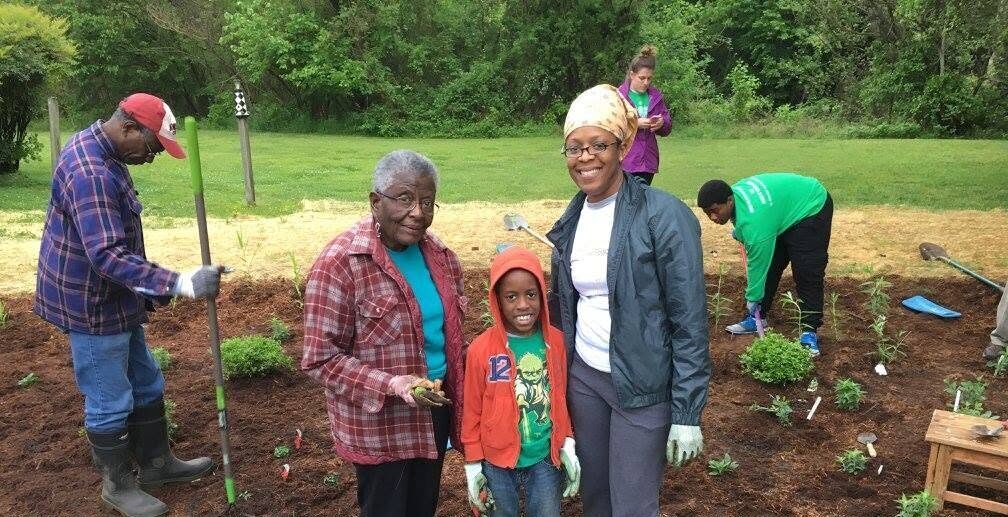
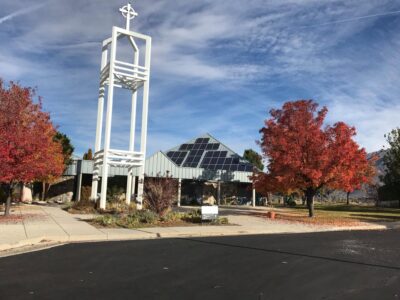
St. Ambrose did not stop at the wetland’s edge. In 2017, the parish installed a 550-square-foot rain garden with a $5,000 grant from American Rivers, matched by City of Raleigh. Two years later, with financial assistance from the city, the congregation built a Prayer Garden and Columbarium, which added two more 100-square-foot bio-retention rain gardens and two 850-gallon cisterns. Christy Perrin, Sustainable Waters and Communities Coordinator at the Water Resources Research Institute, explained that rain gardens are “designed to capture stormwater runoff from parking lots and rooftops, and allow that water to soak into the ground. And the plants also help uptake pollutants in the stormwater.” The walking surface is also loose gravel, firm enough underfoot but porous enough to let rain pass through. Combined, the church says its rain gardens and cisterns now divert “thousands of gallons of polluted stormwater from entering Walnut Creek.”
“A rain garden is very beautiful,” Taylor elaborated. “It helps beautify the campus, and as far as the community, it’s an educational opportunity to educate the community about stormwater runoff, the flowers, and the plants we’ll have in the garden. So it works not only for the church, but for the community at large.” One member of the congregation, Rosie Wright, said, “We are very in tune to how important the wetlands are not only for ourselves and our church community, but for everybody around us.”
Throughout the years, the congregation has expanded its environmental and community impact by installing new heating and cooling systems with increased efficiency, energy-efficient LED lights, and toilets that use 80% less water.
Video Courtesy City of Raleigh
The fruit of that decades-long labor keeps widening. In 2021, the Episcopal Church’s Task Force on Care of Creation and Environmental Racism awarded St. Ambrose a $24,000 grant for “The Healing Pod: Resilience and Resurrection through Education, Spiritual Formation and Healing.” The three-part project combined a podcast on environmental racism, an accessible, Ethiopian-inspired labyrinth, and a therapeutic garden for the community’s emotional wellness. The North Carolina Council of Churches later added an additional grant supporting the same project.
The labyrinth offers “the opportunity to participate in a healing meditative walk that will offer relief from the persistent, ongoing ravages of environmental, economic, physical and psychological discrimination,” while Taylor says the therapeutic garden “uses therapeutic horticulture to help address the mental and emotional health needs of the Black community” by participating in every step of the plant lifecycle.
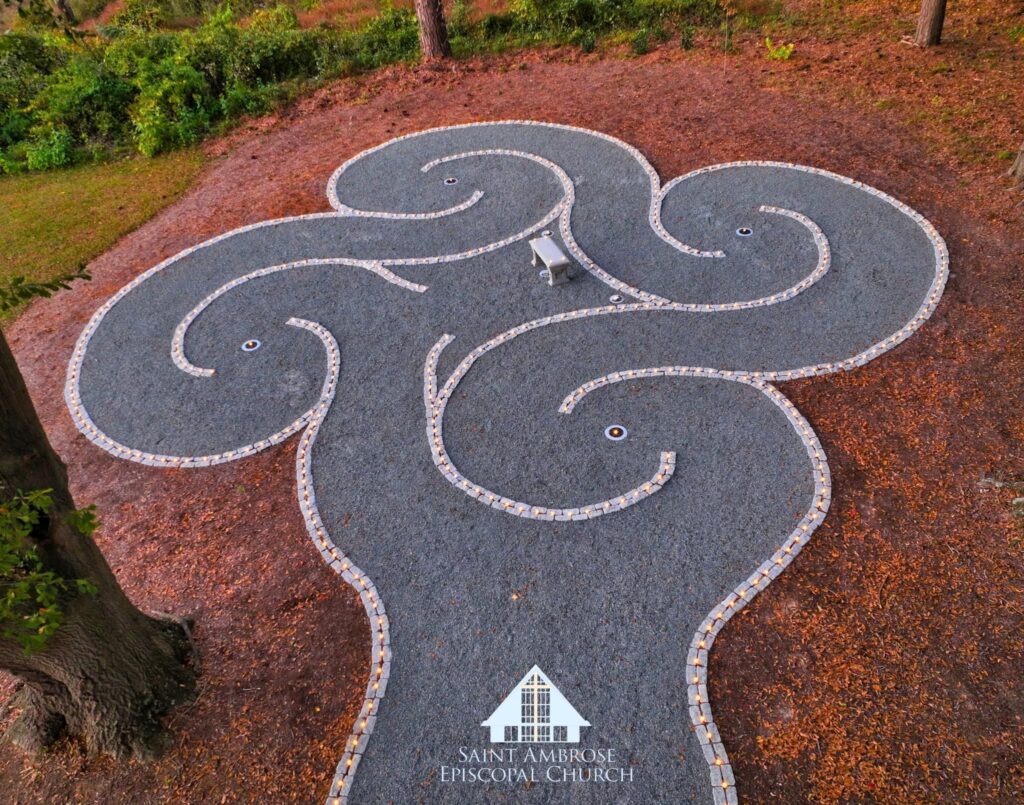
Photo Courtesy St. Ambrose Episcopal Church
St. Ambrose’s efforts reflect a wider institutional commitment. The Episcopal Diocese of North Carolina names creation care as one of five missional priorities, alongside racial reckoning, justice and healing; congregational vitality; discipleship; and collaboration and new communities, a framework Taylor has said sets the tone for congregations across the diocese. “When the top is talking like that, that sets the tone,” he told Thriving Congregations.
A creek that a city once used as a dumping ground now waters a garden built for prayer. The people who first prayed there were the same people the water had once threatened. At St. Ambrose, Amos’s ancient charge has become a description of what happens, quite literally, every time it rains.
 Copyright
2026
Root and Vine
Copyright
2026
Root and Vine